
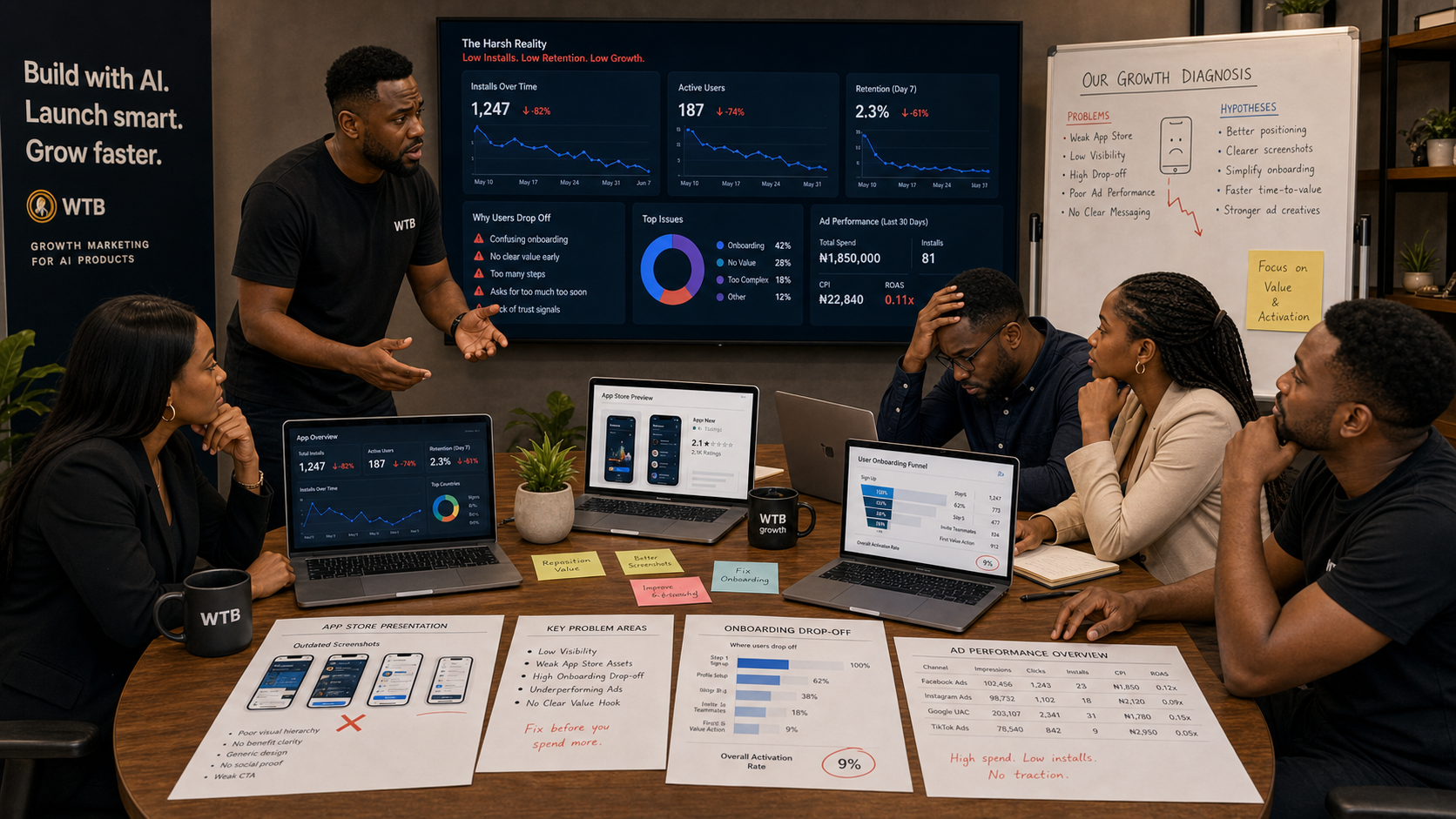
If your AI-built app has no users yet, the problem is usually not “people do not like apps.” It is more often that the market does not understand the value fast enough, the creative is not persuasive enough, or the onboarding leaks interest before users ever reach the good part.
The brutal truth no builder wants on launch week
Making apps is becoming easier. Standing out is not.
One recent 2026 report described how AI-assisted building has lowered the barrier to shipping dramatically, while also flooding the market with new products. Over 414,000 apps reportedly launched in Q1 2026, up 115% year over year. That is the good news and the bad news wearing the same jacket.
Because when everyone can build faster, attention becomes more expensive, trust becomes more selective, and “we launched” becomes much less impressive than founders hope.
So why does your app still feel invisible?
Usually for one of five reasons. Not twenty. Not fifty. Just five ugly, familiar reasons.
1. The positioning is weaker than the product
A lot of AI-built apps are technically capable and emotionally unclear. The founder knows what the app does, but the user still cannot answer one simple question in five seconds: “Why should I care?”
If your app sounds like “an AI-powered workflow assistant for modern productivity optimization,” congratulations, you may have accidentally marketed it to no human in particular.
Users need a simpler promise. Faster invoices. Cleaner leads. Less admin stress. Better habit tracking. Less chaos. More customers. That kind of thing.
2. Your app store page is doing a bad job selling
Apple's own product-page guidance makes it clear that screenshots, previews, and product-page language matter. If your visual presentation is generic, if your screenshots look like they were taken during a hostage exchange, or if your copy explains features without explaining outcomes, users hesitate.
And hesitation is expensive.
3. You are trying to run ads before creative has earned the right to scale
Many founders light money on fire politely by running app ads before they know what story actually makes people stop scrolling. That is why we keep pushing the organic-first and UGC-first angle.
If your message has not already made real people watch, save, comment, click, or ask questions organically, what exactly are you scaling with paid media? Hope?
Better flow:
- test value-led organic video first
- test user-style creator content next
- then promote the creative that already proved it can hold attention
Google's App campaigns can optimize and learn, yes. But they still need better signals and better creative than many founders give them.
4. The onboarding is leaking users before they feel the value
This one hurts because it hides behind the install numbers. A founder may see installs and feel hopeful, but if people bounce before activation, the growth story is fake. You are not growing. You are briefly being visited.
Onboarding friction usually shows up as:
- asking for too much too early
- unclear setup steps
- no strong “aha” moment
- weak explanation of what happens next
- too many choices before trust is built
This is why we keep saying: do not scale ads aggressively into a weak onboarding funnel. That is just paying to discover your own leaks faster.
5. The product is “interesting,” but not yet socially believable
Founders often underestimate how much social proof matters, especially for new apps. People want to see someone like them use it, explain it, benefit from it, and not look confused while doing so.
That is where UGC comes in. Creator-style videos make the product feel more lived-in and less like a founder-only fantasy. They turn your app from “a thing somebody built” into “a thing people might actually use.”
What to fix before you spend harder on ads
Here is the cleaner order of operations.
Fix the promise
Make sure your app can be described in one sharp sentence that a normal user would repeat to a friend without needing subtitles.
Fix the screenshots
Your first visual impressions should show outcome, clarity, and confidence, not just interface fragments floating in emotional emptiness.
Fix the first 30 seconds of understanding
Through landing page copy, app store copy, preview videos, and onboarding, the user should quickly know what the app helps them do and why that matters.
Fix the creator proof
Let real users, UGC creators, or relatable micro-influencers show the app in context. Features feel more believable when life is attached to them.
Fix the onboarding leak
If users arrive and disappear, your acquisition strategy is not your only problem. Your product experience is now part of your marketing problem too.

The smarter founder mindset
The founders who win this next era will usually understand one thing earlier than everyone else: building is not the finish line. It is the starting whistle.
And if you built with AI, that truth becomes even more important. The market does not reward you because AI helped you ship. It rewards you when your app feels useful, understandable, trustworthy, and easy to adopt.
That means the new winning stack is not only code plus launch. It is:
- clear positioning
- strong app-store persuasion
- organic content that teaches the transformation
- UGC that builds belief
- paid iteration built on proven winners
- onboarding that does not waste the attention you paid for
Where WTB fits in
This is where WTB helps founders stop guessing which part is broken. We can help your business diagnose the message, the content, the user acquisition path, the creator angle, the product-page persuasion, and the onboarding leak before you keep throwing more ad money at a system that is not ready.
Because sometimes the real growth move is not “spend more.” It is “fix what the spend is exposing.”
Sources behind this article
This article draws on current reporting and platform guidance, including Business Insider's May 2026 report The guy with a killer idea for an app can finally build it. So can everyone else., Apple's guide to creating App Store product pages, Google's guide to App campaigns, and the research paper Why Early-Stage Software Startups Fail: A Behavioral Framework.
FAQ
Why do many new AI-built apps fail to get users?
Because the positioning is weak, the app-store presentation is unclear, the creative does not make people care, or the onboarding experience leaks users too early.
Should founders run ads immediately after launching an app?
Not blindly. Fix the offer message, screenshots, onboarding, and creative proof first so ad spend has a better chance of converting.
What should founders fix before scaling app ads?
Fix message clarity, product-page persuasion, first-user experience, retention leaks, and creative proof before trying to scale installs aggressively.
Need to know what is actually blocking your app growth?
If your business needs help diagnosing low installs, weak retention, bad onboarding, poor creative, or wasted ad spend, start with our contact page, review Onboarding Funnel Optimization Nigeria, or book a strategy call.